When I first started a nonprofit organization, I was entering a network I hadn’t been part of before. I relied heavily on sponsors to help me build relationships and find my footing.
Colleagues invited me to events. They introduced me to people. Others sent connection emails that helped me build partnerships for the organization. People invited me to speak. Each of those actions helped me reach people I might not otherwise have met.
Without those sponsors advocating for me, I wouldn’t have made it very far. I certainly wouldn’t have built a nationally recognized nonprofit that partners with some of the largest legal and human rights organizations in the country.
For women law firm owners, sponsorship can serve a similar purpose: helping you build relationships, reach new audiences, and pursue opportunities beyond your firm. Alongside the guidance and support of mentors, that advocacy can help you take your next step.
What’s the difference between mentorship and sponsorship?
Mentorship is a developmental relationship. The National Academies describes it as a professional working alliance that develops over time, supporting growth and success through career support and psychosocial support. In everyday terms, that means help building your skills and judgment, along with encouragement, role modeling, and support as you work through challenges.7
Sponsorship is active advocacy for someone’s advancement. In Ibarra, Carter, and Silva’s research, a sponsor goes beyond advice and feedback to use influence with senior decision makers on another person’s behalf. For a law firm owner, that advocacy may happen with a conference organizer, a professional association, or a potential collaborator rather than an employer.1
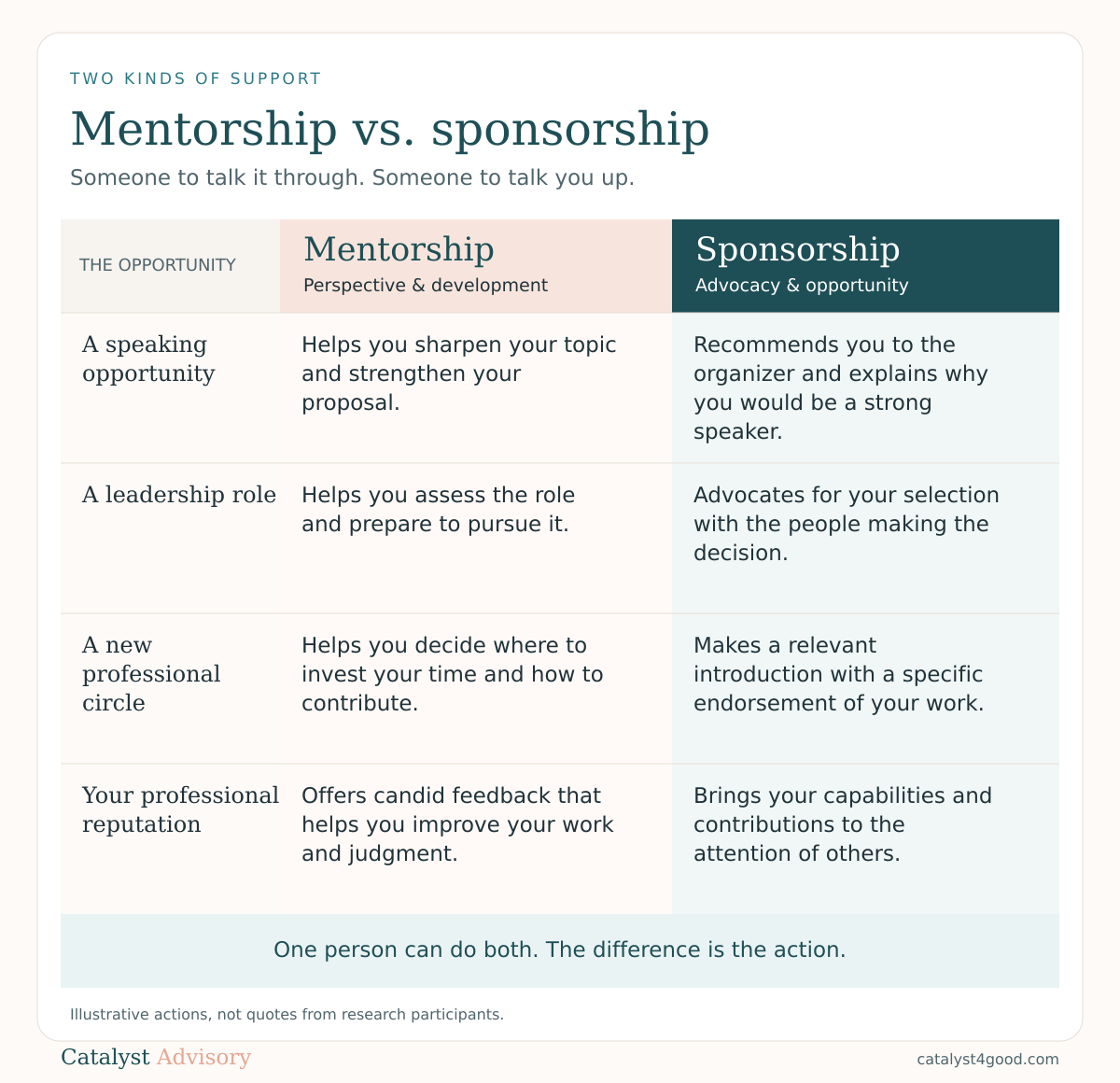
These are overlapping forms of support. Academic models often include sponsorship as a career-support function of mentorship. The practical distinction in the chart below is between guidance you receive and advocacy someone undertakes for you. One relationship can provide both.7
Two kinds of support
Mentorship vs. sponsorship
Someone to talk it through. Someone to talk you up.
Illustrative mentor and sponsor actions for women law firm owners
The opportunity
MentorshipPerspective & development
SponsorshipAdvocacy & opportunity
A speaking opportunity
MentorshipHelps you sharpen your topic and strengthen your proposal.
SponsorshipRecommends you to the organizer and explains why you would be a strong speaker.
A leadership role
MentorshipHelps you assess the role and prepare to pursue it.
SponsorshipAdvocates for your selection with the people making the decision.
A new professional circle
MentorshipHelps you decide where to invest your time and how to contribute.
SponsorshipMakes a relevant introduction with a specific endorsement of your work.
Your professional reputation
MentorshipOffers candid feedback that helps you improve your work and judgment.
SponsorshipBrings your capabilities and contributions to the attention of others.
Illustrative actions, not quotes from research participants. Support can develop within and across organizations.
That last column involves a different commitment. A sponsor is not simply forwarding an event link. She is making a judgment about your capabilities and asking someone else to take that judgment seriously.
That is why a sponsor needs to know your work—not just like your company.
Good advice doesn’t always open the door
Researchers Herminia Ibarra, Nancy Carter, and Christine Silva described high-potential women as “overmentored and undersponsored.”1
A useful question to ask yourself is whether your network of support stops at preparation, brainstorming, and encouragement. You can get thoughtful feedback on a speaking proposal and still need someone to recommend you to the person choosing the panel.
That does not make the feedback less valuable. It means preparation and access are different parts of the process.
If you already have people who help you think, you may not need another person telling you how to get ready. You may need to make your goals clearer to someone who knows your work and has a way to advocate for you.
Sponsorship isn’t just an inside job
When we think of sponsorship, we most commonly think of junior lawyers needing an advocate for a promotion, but law firm owners still need sponsors.
You do not need an executive to approve your next job title. You may still need a conference organizer to consider you, a professional organization to put you forward for leadership, or a potential collaborator to see you as the right person for a project.
Your sponsor does not have to be your boss, older than you, or more senior in every respect. The relevant question is whether that person has credibility and relationships in the setting you want to enter—and is willing to use them on your behalf.
This is related to building a purposeful referral network, but the emphasis here is advocacy. A contact can tell you where an opportunity exists. A sponsor helps someone see why you belong in it.
Does it matter whether your mentor or sponsor is a woman?
Gender can shape these relationships, but it does not tell you everything about what an individual can offer.
In a study of women lawyers, Jean Wallace found different benefits associated with male and female mentors. Women with male mentors had higher earnings; those with female mentors reported greater career satisfaction, stronger intentions to remain in law, and less conflict between work and life. These were associations, not proof that mentor gender caused those outcomes.2
Other research shows why standing matters alongside gender. In a study of recommendations for Supreme Court clerkships, greater tenure among women sponsors was associated with better hiring outcomes for women candidates.3
Research on women entrepreneurs adds another perspective. In a randomized study in Uganda, women entrepreneurs paired with women mentors improved business performance relative to controls. This is a different setting from U.S. law firms, but it offers evidence of the business benefits mentorship can provide.4
Look across genders as you develop relationships. Also look at the person’s experience, judgment, connections, and willingness to act. A woman who understands your situation and has influence in the right setting may offer both perspective and access. A man may do the same.
Make it easier for someone to advocate for you
“Will you be my sponsor?” is a big ask if the person has little idea what you want or how you work. Start with something more concrete.
Know what you want to pursue. A leadership role, a particular speaking topic, or a new professional community gives someone a clearer picture than “I’d like to be more visible.” If the goal is still fuzzy, that is a useful conversation to have with a mentor.
Let people know your work. Share a relevant piece of writing, contribute to a project, or work together on a committee. Give people a basis for their recommendation.
Ask for an action that fits the relationship. You might ask whether someone would be comfortable recommending you to a program organizer. Give her room to say no, suggest another route, or explain what she would need to know first.
Make the next step easy. Send the topic, background, or short description that would make an introduction useful. If someone puts her credibility behind you, take the opportunity seriously and let her know what happened.
You do not need one extraordinarily connected person to become your entire support system. Research on developmental networks offers a broader way to think about support: several relationships, with different experiences and strengths.6
Some people will help you make a decision. Others may be able to recommend you for a specific opportunity. A relationship can change as you get to know each other and your work changes.
Don’t forget to pay it forward.
Don’t forget to intentionally open doors for others.
It can be as simple as sending a connection email—with a specific reason the two people should know each other. Introduce a woman whose work you know, explain what she does well, and say why she would be a valuable person to have in the conversation. You are doing more than passing along a name: you are giving someone a reason to pay attention.
If a colleague’s work makes her a strong candidate for a panel, say so to the organizer. If an employee has done the work behind a successful project, make her contribution visible and consider what she is ready to lead next. If someone asks whom you recommend, take a moment to think beyond the same familiar names.
Be specific about why you are recommending the person. An endorsement grounded in what you have seen is more useful than general praise.
This does not require you to endorse work you do not know, promise an outcome, or say yes to every request. It asks you to notice when you have influence that could make a difference—and decide whether to use it.
It also does not need to be an exchange. The woman you advocate for may never have an opportunity to return the favor directly.
Who’s in your corner?
Take a few minutes to map your circle of support. List up to three mentors, three sponsors, and three people you could sponsor. For each person, name the area where support would help and a specific ask or action. You do not need to fill every space, and the same person can appear in more than one group.
Your circle of support
Good people. Specific next steps.
Who helps you think it through? Who could talk you up? And whose name could you put forward?
Your entries stay in this browser on this device; they are not sent to Catalyst Advisory. Download a copy if you want to keep them. Use initials if you prefer.