When a law firm owner brings me their profit and loss statement, they’re usually looking for me to guide the conversation. Some have barely looked at it. Others understand quite a bit, but hesitate because they’re afraid of getting something wrong.
There can be a sense of shame around that. I own a business. Shouldn’t I understand this already?
But chances are, law firm finance wasn’t a course you took in law school.
Accounting comes with its own language, and it’s different from the language you use to practice law. If no one has walked you through a P&L, it makes sense that you might feel uncertain. That uncertainty doesn’t mean you’re ill-equipped to own a firm. Learning is part of the journey of being a business owner, and you deserve a seat at the table while you’re learning.
The first step is to look at your P&L. Open it. Read it. Get familiar with it. You don’t have to understand every line to start asking useful questions.
When I review one with an owner, I start with the basics—and ask them to stop me if I’m explaining something they already know.
A quick glossary of law firm financial terms
Revenue
Income the firm generates from providing services, before expenses.
Expenses
Costs the firm incurs to operate, such as payroll, rent, software, and insurance.
Net income (or net profit)
Revenue minus the expenses recorded on your P&L. If expenses exceed revenue, the result is a net loss.
Net profit margin
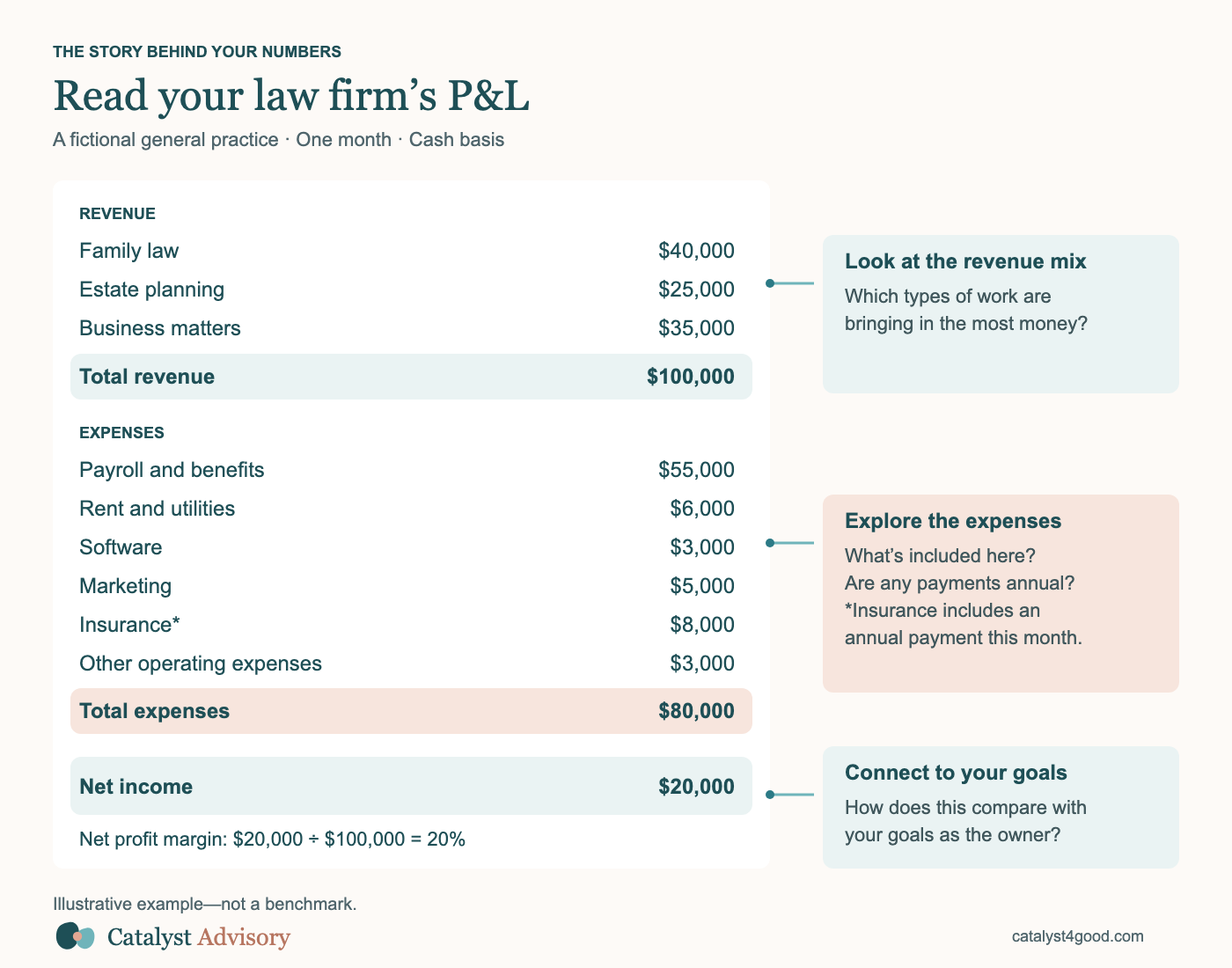
Net income expressed as a percentage of revenue. If your firm generates $100,000 in revenue and $20,000 in net income, its net profit margin is 20%.
Chart of accounts
The categories used to organize your firm’s financial records. The revenue and expense categories shape the detail you see on your P&L.
Reserves
Money the firm has set aside to provide a cushion for unexpected costs, slower periods, or future investments.
Balance sheet
A report showing what the firm owns, what it owes, and the owner’s equity at a particular point in time.
Statement of cash flows
A report showing how cash moved into and out of the firm over a period.
Year to date (YTD)
The period from the beginning of the year through the date of the report.
Cash basis vs. accrual basis
Two ways of recording income and expenses. With cash basis accounting, you generally record income when payment arrives and expenses when you pay them. With accrual accounting, you generally record income when it’s earned and expenses when they’re incurred, even if payment happens later. Know which method your P&L uses, especially when comparing reports.
What does your law firm’s P&L tell you about revenue?
Revenue tells you how much the firm earned during the period covered by the report. But depending on how your P&L is organized, it may tell you more than that.
Often, I see a single revenue line called “Services,” with perhaps one or two subcategories. That gives us a total, but it doesn’t give us much to explore. Breaking revenue out by case type can help us see which types of work are bringing in the most money. If employees work in teams, looking at revenue by team can also help us understand how each group is doing.
That detail doesn’t have to live in your P&L. You might track it in your case management software or in FirmChief. What matters is that you have it somewhere you can access and use.
The categories in your accounting system—called your chart of accounts—help shape the story your P&L tells. You don’t need so many that keeping the books makes you or your bookkeeper crazy. You do need enough detail to start seeing what’s happening in the business.
From there, we can ask questions. How does revenue compare with last year? Are we seeing a seasonal pattern? How does it compare with your goals as the owner? The numbers give us a place to begin the conversation.
What should you look for in your law firm’s expenses?
Next, we look at expenses. What is the firm spending money on? Does anything stand out as high? And what’s included in those categories?
Software is a good example. If that expense looks high, I’ll ask which systems the firm is paying for and how people are using them. Software can be well worth the investment when it helps the team work more efficiently.
But sometimes that conversation turns up subscriptions no one uses anymore, or multiple tools that do the same thing. It’s easy to add something to solve a problem and keep paying for it long after you’ve stopped needing it.
Timing matters, too. Some expenses are monthly, while others come in one large annual payment. If you pay your malpractice insurance annually, for example, you’ll want to recognize that payment when reviewing expenses and plan ahead for the next one. A large bill should be something you’re prepared for.
The amount on the P&L gives us a starting point. Understanding what’s behind it helps us decide whether that spending still makes sense for the firm.
Is your law firm’s net profit meeting your goals?
After revenue and expenses, we get to net profit: what’s left after the expenses recorded on your P&L.
If I’m coaching you, I hope we’ve already talked about your vision for the firm and for your life. That includes your financial goals: how you want to be compensated for your work and what you want the business to generate in profit. Those goals give us something meaningful to compare the numbers with.
Your P&L helps you see whether you’re on target. We can compare profit with your goals and prior years, taking seasonality into account. The conversation is different for every owner.
If you’re exceeding your goals, we may start talking about investing in the next phase of growth. If you’re falling short, we explore what needs to shift. Does the firm need more cases coming in the door? Is the team running into problems getting matters completed efficiently?
The P&L helps us see your progress toward your financial goals. From there, it also helps us identify questions to explore—and answering those often means looking beyond the report.
An illustrative example—not a benchmark. Select the graphic to view it at full size.
What financial information do you need beyond your P&L?
If we’re talking about investing in the next phase of growth, or if the firm is currently experiencing a deficit—where expenses exceed income—one of my first questions is about reserves. How much extra cash does the firm have available?
Most investments cost money before they start making the firm money. Bringing on an employee, expanding a practice area, or putting more into marketing can require spending well before you see a return. You need enough cushion to support that investment while continuing to cover the firm’s obligations. If the firm is operating at a deficit, we need to understand how long that cushion can support it while we work on closing the gap.
Your P&L won’t tell you your reserves balance. That’s where your other financial statements help fill in the picture. Your balance sheet shows what the firm owns and owes at a point in time, including cash and outstanding liabilities. Your statement of cash flows shows how cash moved into and out of the business over a period. Together with your P&L, these reports help us understand the firm’s financial position. We also need to consider what cash is already committed and what expenses are coming up.
If profitability is falling short of your goals, we need to understand where the pain points are. Some common pain points are too few prospective clients coming in or difficulty moving matters through efficiently. Those are different problems that call for different responses.
The numbers tell a story. Talking about what’s happening in the firm helps us understand it—and decide what to do next.
PUT YOUR NUMBERS SIDE BY SIDE
Compare your law firm’s P&L
What changed? How does it compare with your goals? Start with revenue and total expenses, then use the questions to take a closer look.
Differences are actual minus goal, or comparison period minus reference period. Margin changes are percentage points. Percentage changes aren’t shown when the reference is zero or a loss.
Questions to explore
These numbers are a starting point. A change may reflect timing, seasonality, a planned investment, or something worth investigating.
Keep your goals in view with FirmChief
Use FirmChief to connect your financial goals with the work happening in your firm.
Go and look at your P&L with fresh eyes. What is it telling you? How does what you see compare with your goals, and what would you like to understand better?
Ask questions. Simple questions. Hard questions. Self-reflective questions. You deserve to understand your business. If you need someone to walk through the numbers with you, ask your bookkeeper, a fractional CFO, or a coach who can help.
One of my favorite parts of these conversations is seeing the shift in an owner’s confidence—and it usually doesn’t take long. They start asking about something they noticed, pointing out a change, or running some numbers themselves.
You belong in these conversations. It’s your business, and your questions, observations, and goals belong here, too.
Common questions about your law firm’s P&L
What is a law firm profit and loss statement?
A profit and loss statement, or P&L, shows your firm’s revenue, expenses, and resulting profit or loss over a specific period, such as a month, quarter, or year. It’s also called an income statement.
It helps you see how the firm is performing financially and compare results with prior periods and your goals as the owner.
What’s the difference between gross revenue and net income?
Gross revenue is the income your firm generates before subtracting expenses.
Net income, also called net profit, is what’s left after subtracting the expenses recorded on your P&L. For example, if your firm has $100,000 in revenue and $80,000 in expenses, its net income is $20,000.
Revenue helps you understand how much business the firm is generating. Net income helps you understand how much it keeps.
Why does my law firm show a profit when cash is tight?
Showing a profit doesn’t necessarily mean you have extra cash available. The firm may have used cash to pay down a loan or make a distribution to you as the owner. Depending on how your books are kept, some income may also appear on the P&L before clients have paid.
Your P&L tells part of the story. Your balance sheet and statement of cash flows help fill in the rest. If the profit you see doesn’t match how cash feels, ask your bookkeeper or accountant to walk through it with you.
Does my pay as the owner appear on the P&L?
It depends on how you’re paid. If you receive a salary through payroll, that generally appears as an expense on your P&L. Owner draws or distributions generally don’t.
That means net income alone may not tell you how much you’re receiving from the business. When comparing results with your personal compensation goals, you need to understand where your pay shows up—and what sits outside the report.
Ask your bookkeeper or accountant to show you how your compensation is recorded so you know what you’re looking at.
How often should I review my law firm’s P&L?
I recommend reviewing it monthly, once your books are up to date. Look at the month’s results and your year-to-date totals, then compare them with your goals and the same periods last year.
Making this a regular habit helps you get familiar with the numbers, notice changes, and ask questions while there’s still time to act. You don’t need to wait until something feels wrong.
What should I expect from my law firm’s accountant?
Depending on your engagement, your accountant may focus on taxes, keeping the books, or helping you understand the firm’s financial performance. Make sure you know what’s included—and who is responsible for preparing your regular management reports.
For managing your firm, you should have access to an accurate, up-to-date P&L and balance sheet. A statement of cash flows can also help you understand how cash is moving through the business.
Ask when those reports will be ready, how to access them, and whether someone will review them with you and answer questions. Receiving a report is useful. Understanding what it tells you about your business is what helps you make decisions.